

You don't have a marketing problem. You have a systems problem.
Most owners who feel stuck assume more marketing will fix it. It won't, if something's broken at a specific stage of your client journey. In one session, we help you find exactly where you're losing growth and what to build to get it back.
Not ready for a session? Get the DeckSound familiar?
Marketing that happens in bursts then goes quiet
Weaker competitors outranking you
Being busy without being able to say what you built
Leads coming in but the wrong ones, or nowhere
1 / 5
MORE SIGNAL, LESS NOISE.
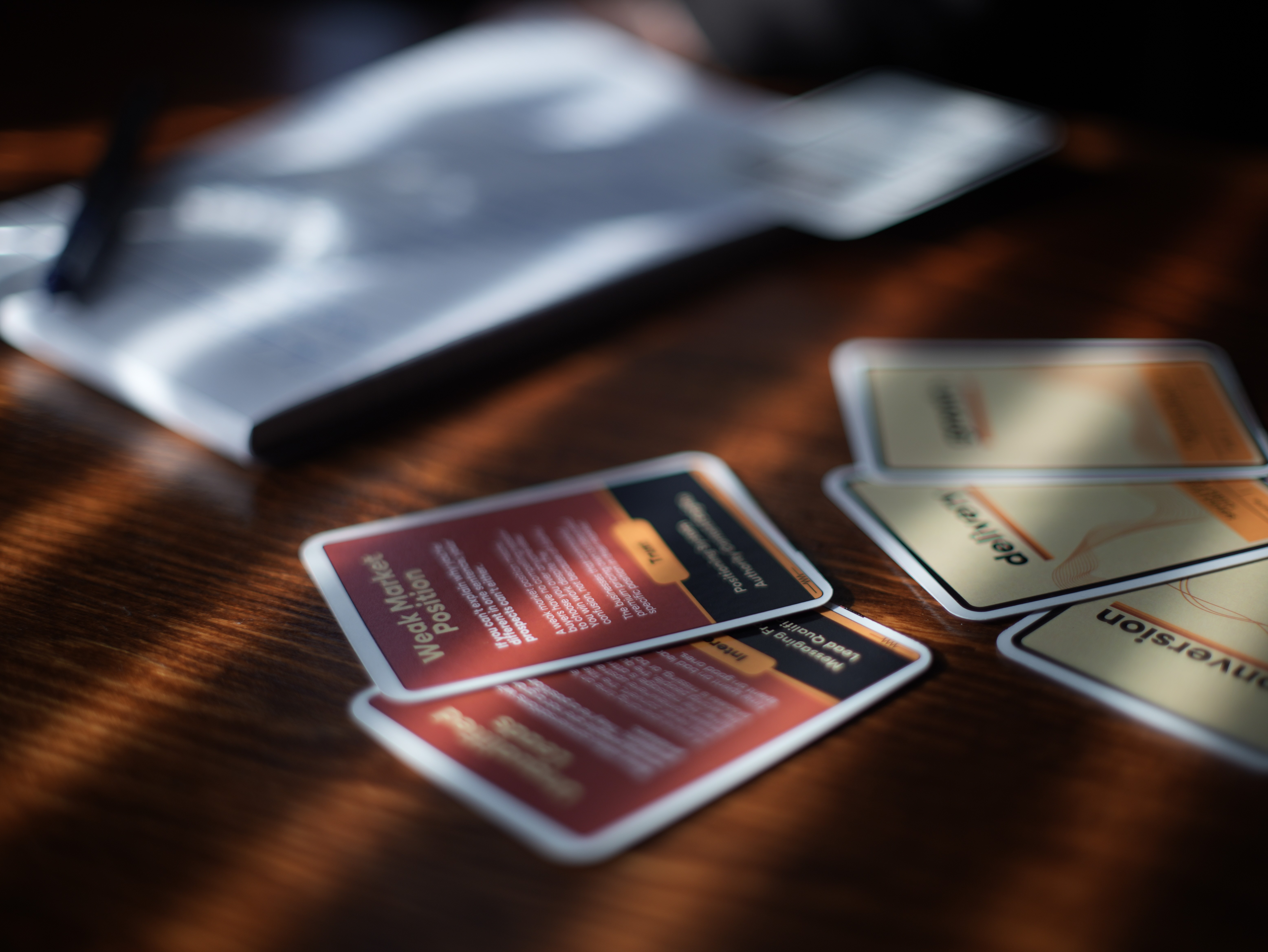
The AMP Deck
The deck doesn't tell you what's wrong. It creates the conditions for you to see it yourself. Which means you own the diagnosis before we ever talk about a solution.
A 52-card diagnostic tool, built around 6 stages every client moves through on the way to becoming a repeat customer Attention, Interest, Trust, Conversion, Delivery, Growth. In one session, you lay your business across those six stages, place the real threats where they're actually hurting you, and walk out with the two or three systems that fix the one doing the most damage.
MORE SIGNAL, LESS NOISE
Get a full roadmap in one sitting
What you walk out with
This isn't a workshop or a vague strategy chat.
It's a 90 to 110 minute working session, run by AMP's Brand Strategist Ash Murrell directly, that ends with a
written summary in your inbox within 24 hours.
What you leave with:
- a complete map of your business across all six stages
- the one threat doing the most damage, named plainly
- the two or three systems that fix it, and why
- a 90-day build sequence
- a written summary within 24 hours.
Price: $750. Guarantee: if the session doesn't give real clarity, the full fee credits toward anything built with AMP in the next 60 days.
We run a small number of sessions each month so each one gets full attention. Live availability is on the booking page.
BUY THE DECK
Want to try it for yourself first?
The AMP Deck is also sold as a standalone product.
The same diagnostic, run at your own table, on your own time.
Every system card linking to more detail on how to build it. If it
surfaces something worth a second set of eyes, booking a session
is the natural next step.
WHAT OUR CLIENTS SAY
Thoughts and notes
from our Clients.
TESTIMONIALS
Justin Davidson
"Before working with AMP, figuring out our next steps felt overwhelming. When I was asked about the direction we wanted to take, I had dozens of different ideas bouncing around in my head all at once and every direction possible. Using the Amp deck of cards completely transformed our planning process. The cards allowed us to instantly simplify concepts, organize scattered thoughts into clear categories, and highlight key areas where we needed improvement. Most importantly, it boiled everything down into the precise, focused campaign our business actually required. Thanks to Amp, we went from creative chaos to total strategic clarity. I am now completely confident that we are executing what is best for our business."
TESTIMONIALS

Tony Chastik
"Honestly, doing The Deck was the most valuable thing I've done to get a real read on my business. It was super straightforward and helped me spot weaknesses I had no idea were even issues. It completely shifted my focus from the setbacks I imagined to the ones actually holding me back. At the end of it all, I left with a clear, actionable plan for getting people interested in my service, building trust, and growing."
FREQUENTLY ASKED QUESTIONS
We get asked
this all the time
Pick a card. Every one is a real objection we hear before a session.
0 / 6 flipped
AMP SERVICES
What happens after
the diagnosis...
Every one of these starts from the same place:
a clear diagnosis of what's actually broken.
Strategy
Positioning, messaging, and the roadmap that ties it together.
Branding
Visual identity systems built to match the strategy, not decorate it.
True Voice
An authority-led content engine, built and run for you.
Campaign Management
Coordinated campaigns across channels, aligned to what the session identified.